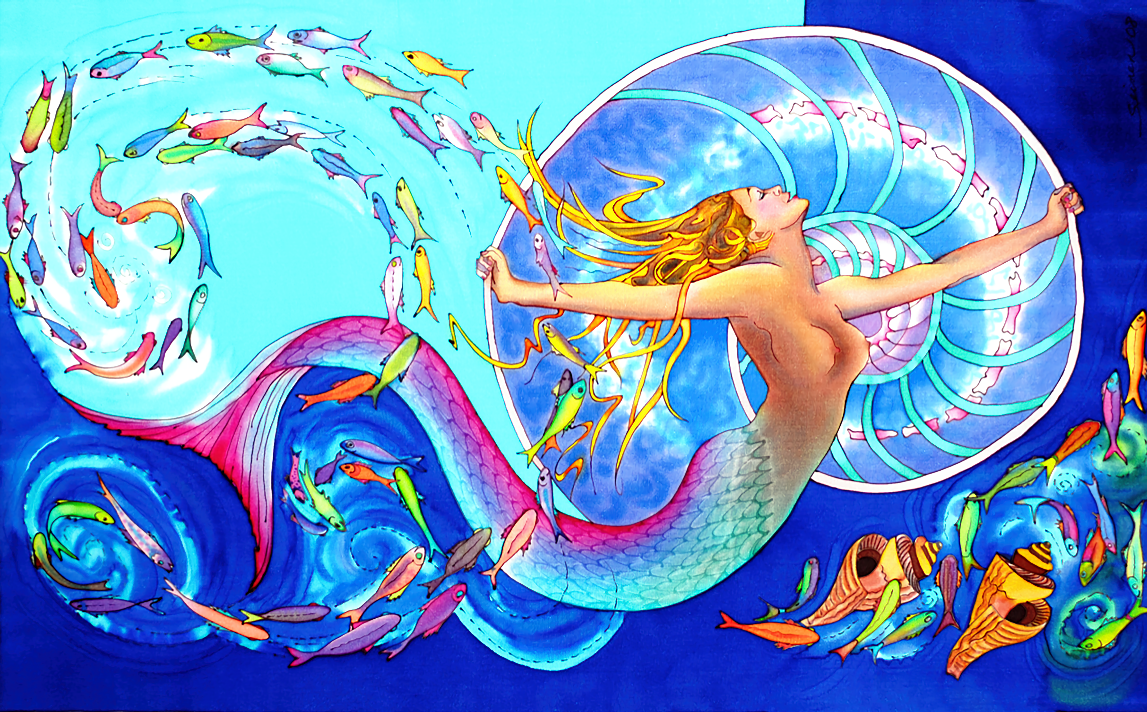

Margriet Seinen painted on silk for over forty years. Starting in 1982 with nothing but silk dyes and instinct, she built a body of work that spans mermaids and mandalas, vivid florals, dancing figures, birds, fish, and the wild natural world she loved deeply.
Her paintings are luminous in a way that is unique to silk. Unlike canvas or paper, silk absorbs dye into its fibers — the color becomes part of the fabric itself, and the natural sheen of the silk gives every piece an inner glow that cannot be replicated.
Today her art lives on in the products available in this boutique. Each item — whether a scarf, a tote, a greeting card, a journal, or a piece of apparel — carries one of Margriet's original paintings. Nothing is generic. Every design began as a hand painted original.
When you buy from Seinen Silk you are bringing home a piece of genuine artistic legacy. Something made with decades of devotion to beauty, color, and the celebration of life.
Browse the boutique and find something that speaks to you.
Seinen Silk
The Legacy of Margriet Seinen

Silk painting is an ancient art dating back to 2600 BC in China. It’s different from painting on canvas or paper because the “paint” doesn’t sit on the surface. Instead, the color is absorbed, becoming part of the protein fiber of the silk. The shine of the silk itself becomes part of the brilliance of the color. The “paint” is a spot of ink or dye in liquid form. To control the flow of this dye, the painter must limit the amount of pigment on the brush or use Gutta / Serti, a latex-based resist, drawn in as a line that stops the flow of paint.
There is no dip dyeing involved. All my pieces are painted with watercolor brushes, and the dye medium is transparent, so “mistakes” cannot be painted over.
I use a ten or 12-momme (weight of silk) Chinese silk habotai as my canvas. When a painting is done, it is wrapped in newsprint, steamed to set the color, then ironed and mounted on foam core to be framed.
The longevity of an original painting on silk is similar to, or better than, a watercolor painting or pastel. Most of the old textiles preserved now in museums are silk. There are Chinese silk paintings from 300 BC that are still intact. However, the most permanent silk dyes are subject to fading over time in bright light, especially sunlight, so paintings should be hung out of direct UV rays. Silk itself is more durable than other fabrics. It is also naturally resistant to various molds and mildews.